
One year into his prime ministership, how to describe Canadian foreign policy and “strategy” under Mark Carney?
Answer: The Prime Minister has signalled clearly that, mentally, he is seized of the country’s grave strategic circumstances. He does not wish for Canada to be a vassal to any country. He certainly does not see himself as subordinate or subservient to any foreign leader.
And yet I submit that Mark Carney’s felt understanding of the policy and societal instruments required to support any serious move to “devassalize” our country remains poor at best, and naïve at worst, even as his marge de manoeuvre is limited by time and circumstances.
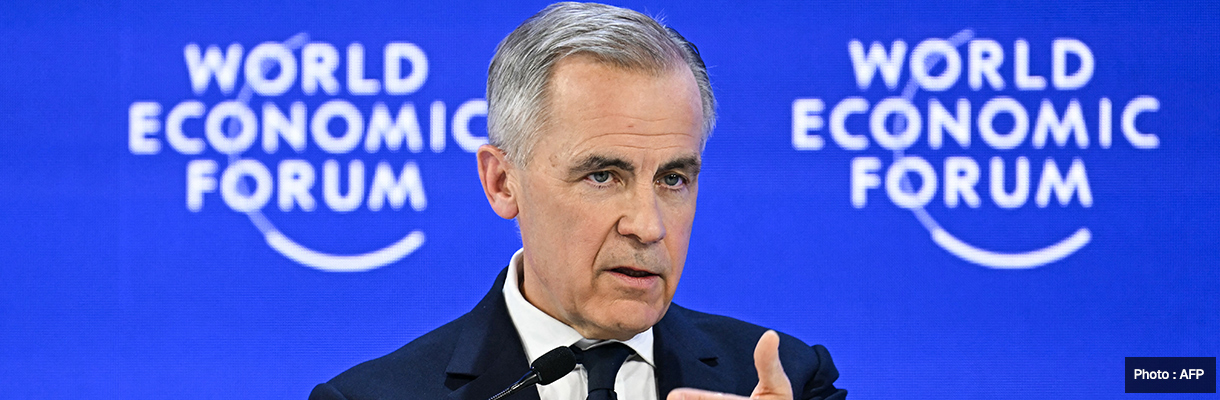
The famous Davos speech
The Prime Minister’s famous Davos speech in January was, for me, incoherent on any intellectual analysis. Its chief virtue was to have shown to Canadians and world leaders that Canada sees not any abstract “rupture” of the “rules-based order” (for the Prime Minister had himself largely supported, à l’improviste, the American action in Venezuela before the speech, and the American-Israeli action in Iran after the speech), but rather that our closest neighbour and longstanding ally, the United States, now harboured an unapologetic interest in vassalizing us at best, and annexing us at worst.
For all practical intents and purposes, President Trump’s threat to annex Greenland was and remains interpreted by the Prime Minister – and properly so – as a contemporaneous threat to do the same to Canada – perhaps starting with our vast Arctic territories. Trump’s growing contempt for NATO in the wake of the war in Iran can only make this threat to Canadian territorial integrity more acute over the coming year.
The Prime Minister also signalled his cold-blooded apprehension that, short of invasion, America now wished to use, as a regular practice, trade and economic regimes to vassalize other countries – starting with our own. Said Carney at Davos: Great powers have begun to use “economic integration as weapons, tariffs as leverage, financial infrastructure as coercion, supply chains as vulnerabilities to be exploited.”
We do not yet know what the U.S. will demand in the context of the CUSMA review process. We should presume that the American “asks” will be exorbitant, if not extortionist – such is the wont of the American president in his second term. These asks may be accompanied by implicit or explicit threats of invasion or expropriation by force.
What we do, at last, realize – seven years after my original warnings – is that the first CUSMA, ratified by Parliament in 2020, succeeded in vassalizing Canada at law with precious little political or public debate. The second largest country on Earth was formally vassalized – and allowed itself to be vassalized – with no one apparently noticing.
How could this be? Answer: article 32.10 of CUSMA has the effect of requiring Ottawa to seek approval from Washington in the event that Canada wished to pursue “free-trade agreements” (read “advanced economic relations” of any species) with “non-market countries” (read “China” or “Russia” or any other countries so deemed by the American president on any given day or via any given tweet.)
CUSMA as a geopolitical agreement
Trump saw CUSMA as a geopolitical agreement. And what we read pedantically as jurists, Trump instead saw as strategic encagement. Prime Minister Trudeau reported the deal back to citizens as an economic triumph for Canada. Trump viewed it as the consummating act of Canadian capture and vassalization.
Trump was working from a far more eclectic, capacious mental map of the world – and of Canada and the U.S. in particular – than our own leaders. Ottawa essentially had a bilateral, Canada-U.S., theory of world affairs. (Does it still?) And yet Trump observed major (competitive) powers like China right at North America’s western borders, and Russia across the Arctic flank today – hence his apparent “security” interest in Greenland.
The remora can live happily beside the shark in mutual amity for a lifetime. But the shark might also eat the remora on any given Sunday. Similarly, even a vassalized Canada can live happily beside an America that is pacific, stable and largely benevolent. But a formally vassalized Canada faced with a predatory presidency is in big trouble – and that is where we are; and the Prime Minister gets this. (So too does the American president.)
The Prime Minister at Davos painted our vassalized country as a “middle power”. This is patently incorrect, and our strategic class must be disabused of this notion and vocabulary. A vassalized country cannot be, by definition, a middle power. And a vassal state surrounded and buffeted by great powers on all sides – as Canada is at present – is even further still removed from “middle powerdom”.
Instead, a brutal fork in the road awaits Canada: we are either a vassal state (or an ever-deeper vassal state over time), or we become a great power in our own right by dint of surviving our wicked, complex circumstances.
Recall that Canada has a four-point game this century: America-China-Russia-Europe (“ACRE”) – all great, nuclear powers, and all at our immediate borders (respectively our southern, western, northern and eastern borders). On the math, this makes for 15 possible combinations of pressures and pulls across our gigantic territory and political economy. Canada cannot possibly be a “middle power” in this game, but it may over time emerge as a great power in its own right – if we survive.
Does Carney understand this dyad of futures gutturally? I am not sure. And yet he must, if he wishes to avoid ever-deepening vassalization.
How to survive as a great Canadian power in the making?
Answer: understand deeply our internal circumstances, and the factors of Canadian strategic power more generally.
The Prime Minister also signalled his cold-blooded apprehension that, short of invasion, America now wished to use, as a regular practice, trade and economic regimes to vassalize other countries – starting with our own.
Difficult negotiations
The Prime Minister is properly working to diversify Canada’s trading and broader economic relationships outside of the U.S., and he is, for now, properly keeping his powder dry in the incipient negotiations with Washington on CUSMA 2.0 (or NAFTA 3.0). He must play for the long haul, resisting any temporary applause (“We have a deal!”) that will cause Canada reputational damage down the line. He must remove 32.10 and make clear that Canada will fiercely rebuff any and all threats and pressure to agree to American demands that seek to vassalize or otherwise strategically cripple or humiliate Canada. Bref, Canada must be – and must be known to be – difficult to deal with! (A no-deal scenario, on this logic, is perfectly acceptable in the short run.)
And yet trade with the U.S. – and trade diversification away from the U.S. – is but one element of Canadian foreign policy and strategic performance. And here lies the nub of the weakness of Carney’s present approach and estimation of the country’s capabilities and prospects.
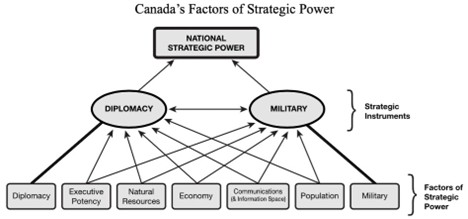
National strategic power is a function not only of the fingers and fist – as it were – but more fundamentally still of the supporting torso and overall corpus on which the force of the fist-punch turns. In other words, a country punches (strategically) not with the fingers, but rather with the entire body mass.
And if trade and diplomacy (and, to be sure, the military) are the fingers of Canadian strategic power, then they are supported – or not – by “factors of power” like our national economy, education, institutions, population and the country’s overall social fabric and mentality (see figure below). And here, post-pandemic, we find Canada’s cardinal problems – problems that undermine more surface-level intentions and achievements at the tentacles of Canadian power.
Multiple systems crises
Why? Answer: Canada suffered multiple systems crises during and out of the pandemic. We cannot wish these away, even we wish to “move on”.
For the record, I do not believe that the Prime Minister has a felt understanding of these pandemic-period crises and the extent to which they bleed, by “entropy”, into Canada’s present and future performance – including in its efforts to resist vassalization or otherwise to devassalize.
Canada collapsed its once-vaunted education systems during the pandemic closures. (On my calculation, over 115,000 young Canadians were ousted permanently from all education during the pandemic. That is nearly the size of our entire Arctic population!) This catastrophe now assumes strategic contours when we understand that our-now undereducated and undersocialized youth form the backbone of tomorrow’s talent and human capital for Canadian strategic power – a very weak backbone at a time of historically high need. The gap is one of potential strategic misery.
Similar destabilization occurred across our economic and institutional systems – including in the information space, where the Americans still control (and can easily manipulate) the platforms and algorithms via which we Canadians imagine we engage in democratic discourse. In concert, all of this has compromised considerably the underbelly of Canadian strategic power at the very moment when it needs to be consolidated and grown. And of this weak underbelly Carney is not intimately seized.
To truly succeed in his task of devassalization, Carney will need to restitch, relegitimate and then reconnect and recalibrate our domestic factors of power – education, economy, institutions, resources, social fabric – with the international instruments of diplomacy and the military. He will need to do this in the ever-perilous context of great confusion among the provinces and cities of Canada as to their appropriate role in “foreign policy”, and growing radicalization among Canada’s wonderful diasporas about foreign causes and “ruptures” that bear little relation to Canada’s own precarious realities.
In the process, Carney will be presiding over the creation of Canada 2.0 – or the Second Canadian Federation, as it were: deep vassal or great power. There is no middle path.