
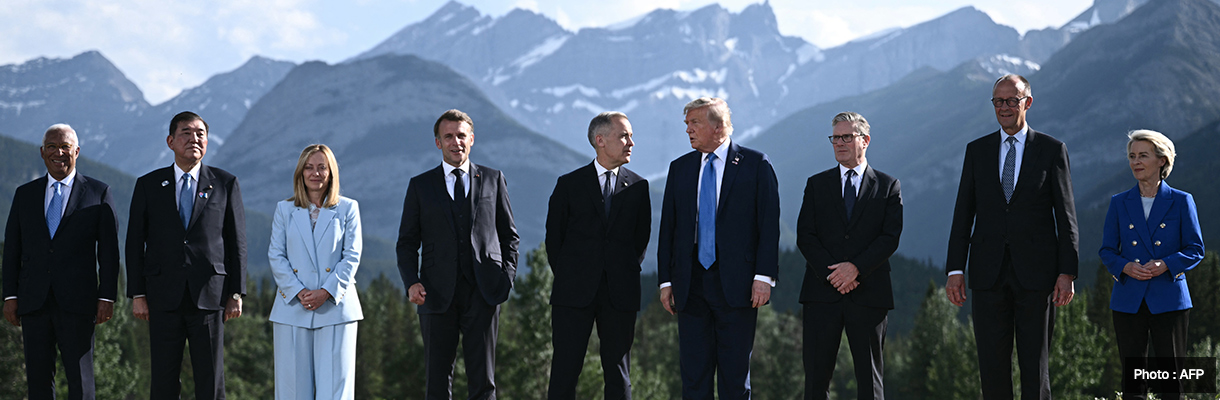

The next two months will feature two key global summits whose success depends more than ever on the often unpredictable US president Donald Trump. The first is the annual Group of Seven (G7) summit in Evian, France, on June 15–17, and since the G7 start in 1975 every US president has faithfully attended. The second, in Ankara, Türkiye, on July 7–8, is the summit of the North Atlantic Treaty Organization (NATO), and those summits have also always attracted Trump and most US presidents too.
There is little doubt that Trump will once again attend both summits, as he did in 2025. On June 16–17 in Kananaskis, Canada, he helped the G7 produce 150 innovative commitments. On June 25 in the Hague, the Netherlands, he helped NATO create 14 commitments, and had the alliance agree to his central demand to increase members’ defence spending to 5% of their gross domestic product by 2035. That new money is now flowing, as European allies and Canadians have more than doubled their defence spending since 2014, investing almost $600 billion in defence in 2025 alone.
Trump will show up
Trump has already said he will probably attend the Evian Summit. He will want to do so to get his fellow G7 leaders to attend the bigger, broader Group of 20 (G20) summit he will host in Miami on December 14–15 and have them return for the G7 summit he will host in 2027. And for NATO, he remains on good terms with its secretary general Mark Rutte, with Türkiye’s President Recep Tayyip Erdogan and with other NATO members such as Poland, whose leader he has invited to his G20 Miami Summit.
A further pull to the G7 comes from the many ways in which its current host, French president Emmanuel Macron, has designed the summit process and priority policy agenda to make it work for Trump. Macron delayed the summit by a day, so Trump could host a mixed martial arts event at the White House on July 14. And he invited Trump to the Palace of Versailles after the Evian Summit, to a banquet mounted in his honour, amidst the golden splendour of the former home of King Louis XIV.
Macron’s Evian agenda is also a set-up for Trump’s priorities and prospective performance at the Miami Summit. Macron’s first policy priority is correcting the global economic imbalances created by China’s predatory trade and monetary policy, which are killing jobs in the US and the G7 as a whole. Also on Evian’s agenda is energy, thrust to centre stage by the wars in Ukraine and Iran. It has fuelled complaints from Americans about soaring inflation, food and gas prices, and driven Trump’s domestic popularity to historic lows, as the mid-term congressional elections on November 6 rapidly approach.
Rutte has also designed the NATO summit with Trump very much in mind. He has focused it on countering Russia’s war against Ukraine, Chinese expansion, North Korea’s threats, and Iran’s nuclear and ballistic missile program. Rutte, Trump and all NATO allies also know they need to convert the new cash they are now producing into hard military power, including drones and air defence systems, faster and in full. They also know they need to replenish their stockpiles, produce and innovate more than their competitors, and, above all, unleash a full defence industrial revolution, across the entire transatlantic defence industrial base, embracing steel, fuel, electricity, skilled workers, robust energy supplies and access to critical minerals. As they do so, Trump will want to reinforce the desire of his NATO allies to have their companies launch new manufacturing in the US, and their governments support US firms such as General Motors and RTX throughout the NATO area.
Indeed, NATO’s Ankara Summit has been designed as a fast follow-up, three weeks after the G7’s Evian one. Both will encourage the entire NATO, EU and G7 economies and societies, including their banks, pension funds and insurance firms, to invest more in defence industry and dual-use technologies, thereby providing long-term economic stimulus for all.
The Evian Summit itself could well produce a significant performance, despite the poor domestic support afflicting several leaders and Trump’s pervasive unpredictability. Evian promises to advance its initial priorities of macroeconomic policy, trade, investment and development partnerships, outreach to consequential partners, the digital economy, artificial intelligence and quantum technologies, and childhood safety. More uncertain is its performance on the now preoccupying priorities of the US-led war against Iran and Russia’s war against Ukraine, and their impacts on G7 and global energy, supply chains, food and financial security, and environmental protection.
Trump, as at Kananaskis last year, will probably not stay at Evian for the G7’s outreach session, where he would have to share the limelight with guests – the highly popular and politically successful Indian prime minister Narendra Modi, and the leaders of other non-NATO countries, including South Korea, Kenya and probably Ukraine’s President Volodymyr Zelenskyy himself. But Canadian prime minister Mark Carney will stay for the outreach session, to add more achievements in diversifying Canada’s partnerships to reduce its dependence on the US, to realize the vision in his widely acclaimed speech at the World Economic Forum in Davos on January 20.
Trump, as at Kananaskis last year, will probably not stay at Evian for the G7’s outreach session, where he would have to share the limelight with other guests.
Uncertainties in Ankara
More uncertain is the progress at Ankara. This dedicated security summit is due to be dominated by the wars in Iran, the Middle East and Ukraine, and the deep divisions about how to bring them to a full, fair, enduring end. Trump stands alone, against all his NATO allies – especially Spain on Iran and all on Ukraine, now that Hungary, long friendly to Russia, elected a pro-NATO, pro-EU government in April. This divide will truly test the talents of Erdogan as host, as Türkiye is a frontline neighbour of Iran, parts of Russian-occupied Ukraine (across the Black Sea), a fragile Syria and Iraq, as well as Russia’s fearful, contested neighbours of Georgia, Armenia and Azerbaijan. Yet Erdogan’s bridge building will be helped by many NATO members’ desire to focus on security in the Black Sea and NATO’s growing links with South Korea, whose leader is an Evian guest.
In all, the two summertime summits should be a successful tag team, helped by Donald Trump as the heavyweight star of both.