


For the better part of a decade, Canadian foreign policy operated on a fairly simple assumption about the relationship between the United States and China: things were going to get worse. Maybe not tomorrow, maybe not catastrophically, but worse in a steady, structural sense. Trade wars, technology restrictions, military signalling around Taiwan, sanctions, industrial policy, supply-chain fragmentation — all of it pointed in one direction.
Ottawa built around that assumption.
Mark Carney’s government is now discovering that the real danger for Canada may not come from escalating confrontation between Washington and Beijing at all. It may come from something much messier: a world in which the United States and China remain rivals while still cutting deals, stabilizing tensions when necessary, and managing the relationship directly between themselves.
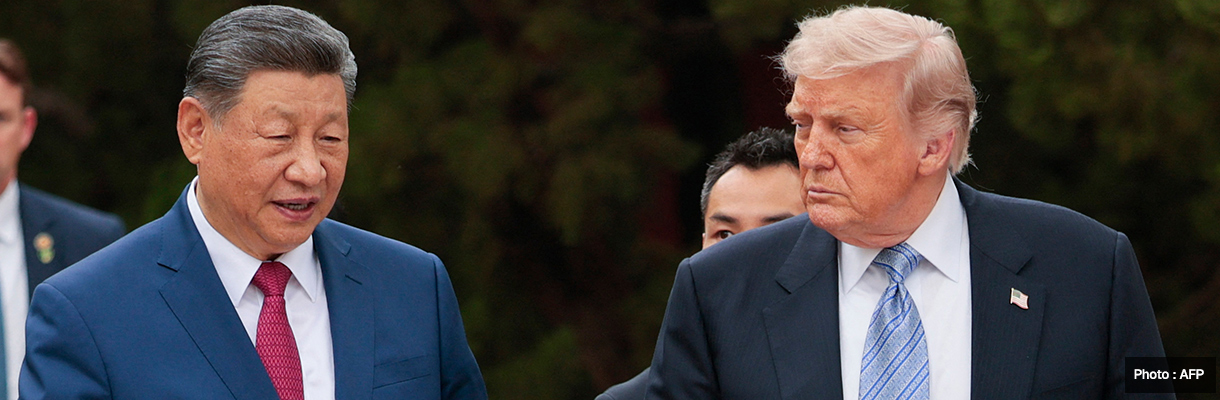
That is the real significance of the Trump–Xi summit in Beijing last week.
The headlines were predictable enough. Strategic stability. Constructive engagement. Responsible competition. None of that language should be taken too literally. The Americans and Chinese are not suddenly becoming partners. Taiwan remains explosive. Technology restrictions are still in place. Military competition in the Pacific is not disappearing. The summit produced a framework for deeper cooperation on trade and some economic gains, but the more consequential technological competition — over AI, export controls, and digital sovereignty — went largely unresolved.
Some problems for Canada
Still, the broader pattern matters. Washington and Beijing increasingly look less like two powers stumbling blindly toward rupture and more like two great powers trying to prevent rivalry from spinning fully out of control.
That creates problems for Ottawa.
Carney came into office facing a relationship with the United States that had deteriorated more seriously than many Canadians wanted to admit. Trump’s tariff pressure, his rhetoric about allies, recurring tensions over defence spending, and disputes over industrial policy all pushed Ottawa toward a conclusion that would have sounded politically dangerous only a few years ago: excessive dependence on the American economy had become a strategic liability.
Carney has said as much publicly.
That matters because it helps explain the government’s attempt to reopen relations with China. Too much commentary in Canada still treats the China reset as though it were either naïve idealism or some kind of geopolitical flirtation. It is neither. Ottawa is responding to structural pressures that are becoming harder to ignore.
China remains one of the largest markets available to Canadian exporters. Provincial governments want access. Agricultural producers want access. Universities want Chinese students back in large numbers. Canadian firms looking at stagnant growth prospects in North America want access as well. None of this disappeared because relations froze during the later Trudeau years.
Quebec illustrates the stakes as clearly as anywhere. Montreal’s universities — McGill, Concordia, the Université de Montréal, UQAM — have faced serious international enrolment pressures in recent years, and any sustained improvement in Canada–China relations would matter to them directly. Quebec’s pork producers lost meaningful market access when China imposed retaliatory tariffs, and relief has been partial and uneven. Quebec’s clean-tech and battery ambitions give the province a direct stake in any Canada–China opening on energy and industrial cooperation. Add the Montreal business community’s exposure to Pacific investment flows and supply chains, and the China file starts to look less like foreign policy abstraction and more like a direct economic question with a very specific Quebec address.
The shift under Carney has therefore been more pragmatic than ideological. His visit to Beijing from January 14 to 17 — the first by a Canadian prime minister since 2017 — was not an attempt to resurrect the old fantasy of seamless engagement. Nobody serious in Ottawa believes that version of the relationship is coming back. The government is trying instead to carve out a narrower, more transactional relationship focused heavily on trade, investment, energy, and selected areas of industrial cooperation.
In other words, Ottawa is trying to hedge.
The problem is that great powers do not necessarily like hedging behaviour from secondary states once rivalry hardens into alliance discipline.
That is where last week’s summit becomes important for Canada in ways that are easy to miss.
For years, many Canadian policymakers quietly assumed that worsening U.S.–China tensions would increase Canada’s strategic importance to Washington. The logic seemed straightforward enough: if the Americans needed reliable allies for economic security, continental defence, critical minerals, Arctic surveillance, and technology supply chains, Canada’s leverage would naturally grow.
Maybe. But that logic depends on the assumption that the United States wants disciplined alliance cohesion above all else.
Washington and Beijing increasingly look less like two powers stumbling blindly toward rupture and more like two great powers trying to prevent rivalry from spinning fully out of control.
Washington demand tighter alignment
Trump has never really approached international politics that way. His foreign policy has always been more transactional than ideological — he pressures allies while negotiating directly with adversaries, speaks the language of confrontation while still looking for bilateral bargains. The result for countries like Canada is a strange dynamic: Washington may pursue selective accommodation with Beijing while simultaneously demanding tighter alignment from allies on technology, trade, defence spending, and industrial policy.
From Ottawa’s perspective, this is a difficult position to inhabit. Canada is trying to diversify economically at precisely the moment the United States is becoming less tolerant of allied ambiguity toward China.
There are already signs of strain. The recent suspension of Pentagon participation in the Permanent Joint Board on Defense was not some bureaucratic misunderstanding. It reflected growing American frustration with Canadian defence policy and burden-sharing. At the same time, Ottawa is reopening economic channels with Beijing. Viewed separately, neither development looks decisive. Taken together, they point toward a more uncomfortable strategic environment for Canada than the one policymakers in Ottawa spent years preparing for.
Beijing, for its part, is not behaving irrationally here. Chinese officials understand perfectly well that tensions inside the Western alliance system create opportunities. China does not need Canada to become anti-American — it simply benefits from a Canada that behaves with a little more autonomy and a little less automatic alignment. That objective fits neatly with Beijing’s broader approach to the current international system. China increasingly prefers a world of partial alignments, fluid partnerships, and weakened alliance discipline, with no interest in reproducing the rigid Cold War structure that once constrained Soviet influence.
The irony is that Canada may want something similar.
Ottawa clearly does not want to break with Washington. Geography alone rules that out. Continental defence, trade integration, NORAD modernization, and supply-chain interdependence ensure the United States will remain Canada’s central strategic partner regardless of who occupies the White House. Yet Carney’s government also seems increasingly unwilling to organize Canadian grand strategy around near-total dependence on the United States. That is the shift now underway.
Whether the strategy succeeds is another matter. Middle powers often assume they have more room for manoeuvre than they actually possess once major powers begin managing the international system more directly. Canada has historically done well in relatively open international environments where rules, institutions, and multilateral frameworks softened the harder edges of geopolitical competition. The emerging system looks different — more transactional, less universalist, less interested in pretending economics can be separated cleanly from strategy. Great powers are once again negotiating over spheres of influence, industrial dominance, technology access, and regional balances in ways that feel far older than the language surrounding them.
The Trump–Xi summit last week did not resolve any of this. What it confirmed is that the two largest economies in the world are managing their rivalry on their own terms, on their own timeline, with secondary states largely watching from outside the room.
For Canada, that means the strategic improvisation of the past few years — diversify, hedge, keep options open — is running into its limits. A more deliberate approach is needed: one that defines where Canada’s economic diversification ends and its alliance commitments begin, and that makes that boundary legible to both Washington and Beijing.
Ottawa is beginning to grasp the problem. Grasping it and having a strategy for it are different things.