

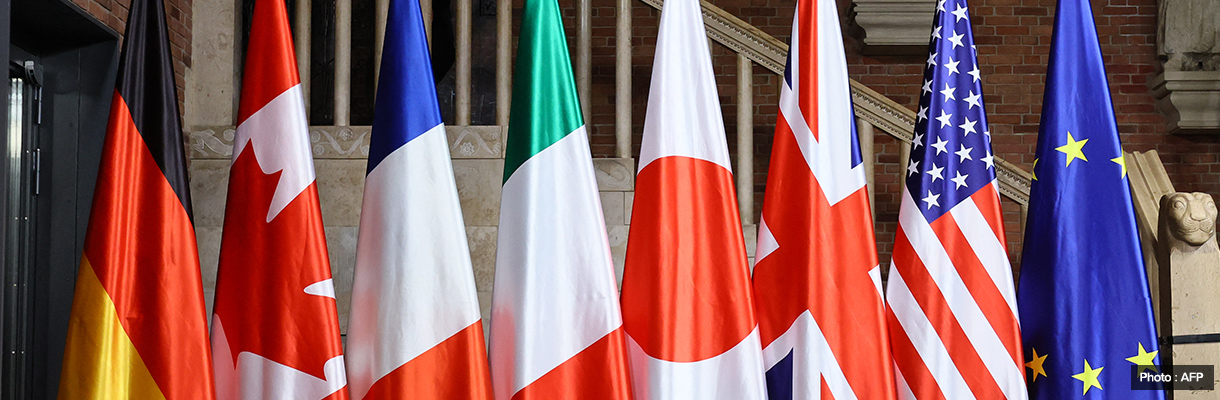

The G7’s Kananaskis Summit on June 15–17, 2025, presents many momentous and some unprecedented challenges – for the group and for Prime Minister Mark Carney as its Canadian designer, host and chair. Those challenges come in three categories: global crises, US President Donald Trump and Mark Carney himself.
The first two are so formidable that some doubt that Carney can mobilize his impressive talents to match the moment and make the Kananaskis Summit a success. Yet he probably can, and will.
Global Crises
The global crises start with the deadly wars by Russia against Ukraine, in the Middle East, and between nuclear-armed India and Pakistan, and the threat of war from China and North Korea. They include foreign interference from state and non-state adversaries against countries, companies and citizens, through cyberspace and traditional ways.
The economic crises centre on the tariff wars started by Trump against his G7 partners, China and many other countries. They were punctuated by a threat in late May to impose a 50% tariff in a week on the European Union, the world’s largest economic actor, before a delay to July 9 a few days later. The tariff war comes amidst rising financial instability and a potentially contagious global financial crisis sparked by rising government deficits, debts and interest rates in the US, Japan and many countries in the impoverished developing world. Also in the mix is the artificial intelligence revolution, with its many risks as well as rewards.
The ecological crises come from the extreme weather events such as wildfires, floods, droughts and heatwaves. They are fuelled by climate change, relentlessly rising beyond the 1.5°C post-industrial temperature increase that scientists have warned is critical and that countries agreed to defend in their UN Paris Agreement in 2015. They embrace the rampant biodiversity loss that compounds the climate crisis and creates agriculture and food loss, pandemics and mass migration in illegal and deadly ways.
Their self-reinforcing combination presents unprecedented high threats to national and human values. They erupt in sudden, surprising ways, and give even the most powerful leaders of the world’s most powerful countries little time to respond, as they swiftly spread across borders and around the world.
The G7 leaders at Kananaskis must thus come together to prevent, respond to and repair this panoply of crises with strong, smart, solutions more than ever before.
Donald Trump
Doubts about G7 leaders’ ability to do come from the second challenge, now arising inside the G7, from the most powerful leader of the most powerful country in the world. The Kananaskis Summit is Trump’s first full outing on the full world stage in his second term. He comes backed by a fresh mandate and a majority for his Republican Party in both chambers of the US Congress. Trump has promised and started to produce a transformational, anti-democratic revolution, including threats to annex Canada through economic force and the imposition of massive new tariffs on it, the other G7 partners and many others outside. He has also wavered in his support for a democratic Ukraine facing Russian aggression, withdrawn the US from the World Health Organization and the Paris Agreement and even denied that climate change exists.
But as Kananaskis approached, he has reduced or delayed his tariffs on Canada and other G7 partners. He publicly declared he would come to this G7 summit, as he did to everyone in his first term. Because he said he could boycott the G20 summit in November in South Africa, he has every incentive to produce at Kananaskis big wins for which he can and will take the credit. He allowed his foreign and finance ministers to attend their G7 lead-up meetings and make important progress there across many subjects, notably continued support for Ukraine and sanctions on and reparations from Russia to rebuild a post-war Ukraine that is sovereign, free and whole. That progress even included maritime port security and prosperity in the face of “extreme weather events,” and commitments on supply chains for “clean energy” and “Climate Resilient Debt Clause and Insurance” for vulnerable states.
Trump’s persistent unpredictability could still disrupt and even destroy the Kananaskis Summit. But he always wants to be the centre of attention, to get all the credit for the wins it will produce, and to set up the G7 summit he will host in two years, in person, in the US, as the Covid-19 pandemic prevented him from doing this during his first term.
At Kananaskis Carney must be patient, self-controlled and unprovoked, when his expertise, experience, intelligence and proven success in global economics and finance confront a US president with little of these attributes.
Mark Carney
The third challenge is for Carney. He must give Trump his fair share of the limelight and credit, while producing the substantive achievements to control the global crises too. Carney comes to Kananaskis to do this on his first full outing on the world stage, at the centre of global governance. He comes as a G7 leader with a strong, fresh mandate from his citizens at home. He brings extensive G7 experience, having attended summits as a senior official in Canada’s Department of Finance, governor of the Bank of Canada and governor of the Bank of England. He helped solve the 2008 global financial crisis and Britain’s Brexit financial crisis afterward. He also has senior private sector experience, and he was a pioneer in developing climate-friendly finance.
Now he must deliver on the very broad, ambitious and innovative priorities he has set for Kananaskis. Those begin with security and safety for citizens, communities, and countries at home and abroad. Supporting a sovereign Ukraine against Russia aggression comes first, especially as Carney has invited to his summit President Volodymyr Zelenskyy of Ukraine and Mark Rutte, secretary general of the North Atlantic Treaty Organization.
The second priority is accelerating energy security and the digital technology transition. This means reinforcing the rewards, reducing the risks of artificial intelligence, and driving its adoption in the public and private sectors and in medium and small enterprises and in poor countries, to prevent a new digital divide. It includes ensuring that the enormous power AI that needs comes from clean energy and mobilizing the potential of quantum technology for economic growth and solving global problems.
The third priority is critical minerals supply chains, with Canada leading partnerships to get the minerals needed to drive future technologies.
The fourth priority is wildfires, by mobilizing multilateral action to prevent, suppress and recover from their devastating proliferation in Canada and abroad, fuelled by climate change.
The fifth priority is migration, by addressing both the global pressures causing it and fostering the legal, humanitarian and economically enriching movement of people.
The sixth priority is combatting transnational repression and foreign interference, to protect citizens’ rights and their state’s sovereignty.
The seventh priority is expanding international partnerships by catalyzing private investment in infrastructure to produce better jobs, careers and businesses in Canada and abroad.
Carney and his G7 colleagues also must make progress on conflicts in the Middle East, China, and brewing financial instability from the US due to its soaring government annual deficits, accumulated debts and resulting interest rates lenders demand to finance them.
Above all, he must contain or cut the costs of Trump’s ongoing tariff war, and Trump’s threats to Canada’s independence itself.
This is a tall order to deliver for Carney, the first leader to take the G7 summit chair so soon after becoming his country’s elected leader. And at Kananaskis he must be patient, self-controlled and unprovoked, when his expertise, experience, intelligence and proven success in global economics and finance confront a US president with little of these attributes but lots of self-confidence he likes to exude.
Conclusion: Prospects for Performance
Mark Carney and his G7 colleagues can and probably will pull this off and produce a significant summit success. Carney will get help from the other G7 leaders that Trump likes and respects, led by Italy’s Giorgia Meloni, Britain’s Keir Starmer and even France’s Emmanuel Macron. There are many important agenda items, close to Trump’s priorities, on which they can agree, including stopping opioids and fentanyl, illegal migration, and assaults from China of many sorts. And Trump will not want to tarnish the golden G7 summit, before he has his last chance to design and produce his own, now in person, at home, two years from now.